
As many customers have already started their journey of migrating from on premise SAP ECC to S/4 HANA on RISE with SAP contract. The question that almost every SAP custojmer have asked.
“What happens to all of our custom ABAP code based ECC interfaces and batch jobs extracting data from SAP tables and generate OS level files for downstream systems?”
This is quiet a valid concern. Many enterprises have built hundreds of integrations in ECC over the years. Some feed warehouses, banks, logistics providers, manufacturing systems, reporting platforms, or external partners. These integrations have often been running reliably for years—sometimes decades. And the most common preference is i’d not like to change anything since they are working. The challenge is that many of these integration designs were built for an on-premise ECC world.
How most integration traditionaly work in SAP ECC wile being on premise?:
In a typical ECC environment, the inbound and outbound integration pattern of SAP looked something like this:
- A custom ABAP program reads SAP tables directly. Sometimes from multiple tables or views for outbound process.
2. A scheduled background job executes the extraction for both outbound and inbound processes.
3. SAP formats the data into a TXT, CSV, or fixed-length file for both inbound and outbound process.
4. The file is stored on the application server.
5. FTP or SFTP transfers the file to an external system and vise a versa.
There is nothing inherently wrong with this approach. It was the standard architectural pattern for many SAP landscapes. However, S/4HANA Cloud introduces a different philosophy.
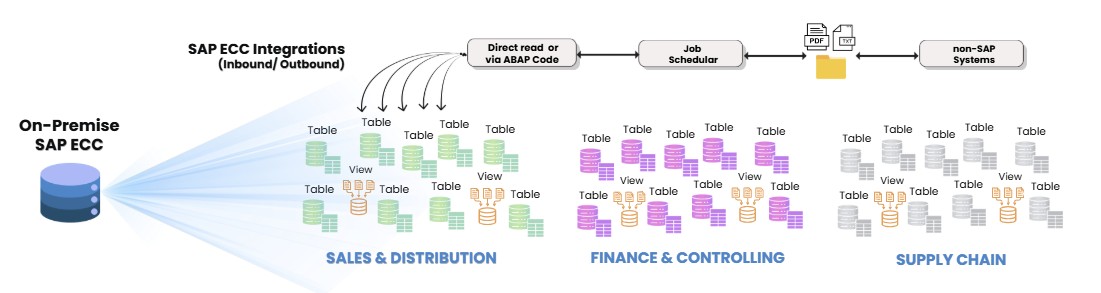
Where the shift in thinking needed when comparing this scenario for SAP S/4HANA on RISE with SAP Cloud
The key difference in ECC database table and views vs S/4 HANA database tables and views is simplification. S/4 HANA is designed with a key focus on simplified table structures reducing the overall size of data, significantly high performance, and low maintenance. One of the most important principles behind SAP’s S/4 HANA cloud strategy is Clean Core. Which must be integrated for all your ECC integrations possibly designed with old school concepts that will result limititations and restrictions as your data grows every day.
With the constantly changing technology and market trends, Instead of building extensive custom integration logic inside the ERP system, SAP encourages organizations to:
- Access business data through supported APIs which are built on provent methodologies
- Reduce direct dependency on underlying tables by reding from views instead of tables reducing lot of risk to your data
- Move integration logic into SAP BTP to gain the advantage of transparancy, efficiency and security
- Centralize monitoring, security, and connectivity to all your inbound and outbound integration processes
SAP BTP Integration Suite is well positioned as the integration platform for connecting SAP and non-SAP applications while providing API management, cloud integration capabilities, and connectivity across hybrid landscapes. Read more..!
What the Future-State Architecture Looks Like for your integrations?
In a modern S/4HANA Cloud world, the same business requirement for integrations can be achieved differently. Below diagram explains high level process.
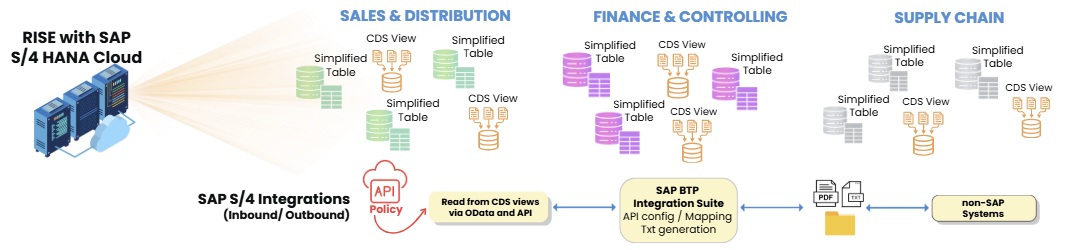
The file may still exist, the business process may still exist, but the architecture is significantly more future-ready. The new API policy is enforced by SAP to enforce clean core principles within your S/4 HANA systems that will raise some restrictions on the data push and pull michanism that integrations heavily relies on. Only certified API’s are permitted to read or write, massive data extracts will be flagged for redesigning, any large integration processes that can throw nagative impacts on the performance of you S/4 system will be banned and only integrations reading from new CDS views of S/4 HANA will be permitted for security reasons.
In a modern S/4HANA Cloud landscape, the same business requirement can be achieved differently.
Instead of SAP building and sending files directly, S/4HANA Cloud exposes data using APIs, and SAP BTP Integration Suite performs the transformation and delivery using Odata services, SOAP and APIs. SAP describes Integration Suite as the platform for connecting SAP systems with external systems and handling integration scenarios.
What SAP customer must evaluate before actual migration?
Rather than asking “How do we move our ABAP extraction program?” ask “Why does this integration exist, and what is the best architecture for it going forward?”
Consider following when you plan to migrate your ECC integrations:
Identify Direct Table Access: Ask your developers, Does the integration rely on direct database access? Is an API available for it in S/4HANA Cloud?. Where possible, replacing table-based integrations of ECC with S/4 HANA supported APIs to reduce future upgrade and maintenance risks.
Separate Business Requirements from Technical Design: Many SAP customer discovers that business requires a file but they don’t understand the ABAP code requirements. Another words requirements for .TXT, .PDF or .DOC file remains, but the complex ABAP code extraction logic was never addressed for stress test or its supportablity for future data growth. Identify them all and consider them for re-design for future use.
Move Integration Logic Out of ERP: Transformation, routing, formatting, monitoring, and partner connectivity can be centralized within Integration Suite rather than embedded inside S/4HANA Cloud. SAP Integration Suite provides integration flows, API-based connectivity, and support for integrating SAP and third-party solutions.
Use the Migration as your Cleanup Opportunity: Most organizations have integrations that are no longer used, duplication of existing ones, were created for one-time requirements and never bothor tuning it, lacks documentation.
A RISE transformation is an ideal time to rationalize and simplify the integration landscape.
The Real Opportunity:
Below video shows the high level integration transition scenario of your S/4 HANA migration journey.
The biggest value of RISE with SAP is not simply lifting existing interfaces into the cloud. Read more..!
The value comes from adopting a modern architecture where:
- S/4HANA Cloud focuses on business processes and data
- APIs become the preferred integration mechanism
- SAP BTP Integration Suite becomes the central integration hub
- Custom ERP code is reduced
- Integration governance improves
Customers who approach integration transformation strategically often gain far more than a technical upgrade—they create a foundation that is easier to maintain, integrate, and scale for years to come. The final thoughts on the best integration migration strategy are
If your migration plan currently says: “Convert all ECC interfaces to S/4HANA Cloud”
pause and ask: “Which of these interfaces should be redesigned rather than simply migrated?”
That conversation often unlocks the biggest long-term benefits of a RISE with SAP transformation.
Please reach us at info@hnit.ca for more details. Our SAP certified team can help you with in-depth analysis for your S/4 Journey.